Brain-to-Text Decoding with Only Minutes of Labelled Data Using MEG-XL
MEG-XL adapts to new subjects with less labelled data and offers a strong baseline for the 2026 PNPL competition’s broad track.
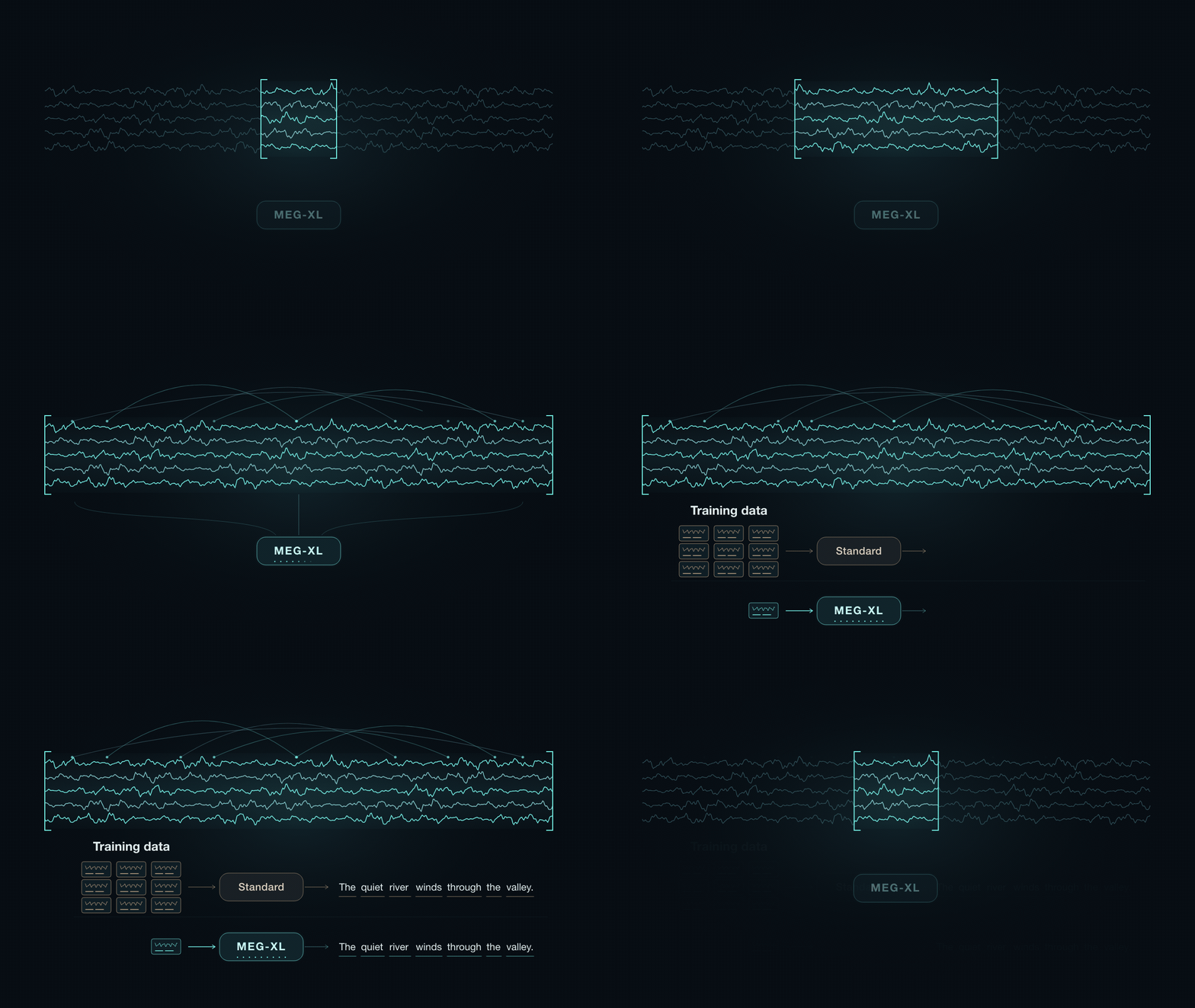
Participants in the 2026 PNPL competition (Mantegna et al. 2026, https://libribrain.org/) have been competing on two largely different tracks. In the first – the “deep” track – the objective is to decode the words that a single subject listened to from their neural activity. This dedicated individual spent more than 80 hours in a MEG scanner listening to stories, podcasts, and other recordings, providing a large volume of training data. However, our ultimate objective is for models to generalise to paralysed patients, for whom collecting 80 hours of data would be difficult, thus necessitating minimising their scanning time. Therefore, the “broad” track examines how successfully models can generalise to 32 different subjects when provided decreasing amounts of fine-tuning data, down to only a few minutes of training data.
This regime, where training data is limited, is a fundamental challenge for brain-to-text. With enough recordings for a single person, a model can gradually learn better representations of their neural activity and improve accordingly (Özdogan et al. 2025). In contention with this, future patients should not require spending tens of hours producing training data before a system is useful to them. Ideally, a model should already learn how to generalise to new subjects from prior examples, and require only a small amount of new data to adapt to a new user. This is the motivation for pre-training.
Instead of learning brain-to-text from scratch for every new subject, we can first pre-train a model on a large volume of neural data collected from many people and hope that it learns a general structure in brain activity that transfers to individuals never seen before. This idea is common in machine learning and has motivated a growing number of pre-trained or “foundation” models in the field (e.g. BBL from Jayalath et al. 2025 and BrainOmni from Xiao et al. 2025). However, we believe that existing approaches for pre-training have so far overlooked an important dimension of information for speech decoding: time.
Brain activity during speech has temporal dependencies
Many existing models, including pre-trained models, are trained on short snippets of neural data, lasting only a few seconds at most. This is a fairly natural design choice as the intended task is usually to decode something short, such as a word (which lasts on the order of a second in speech). The problem is that the brain does not necessarily process each word independently. For example, phonemes form a word, words form sentences, and sentences form longer narratives. Thus, knowing that the start of a sentence is “The cat in the” makes it much likelier that the next word will be “hat” and not “office.” Similarly, neural activity associated with prior words may help to predict future ones. Moreover, neural recordings may also contain slower structure unrelated to the particular word, such as characteristics of the subject, the session, and noise characteristics, that can be helpful for a model. Thus, shorter snippets of neural data may omit context that helps with decoding.
As an analogy, Ilya Sutskever gave the example that an LLM could use the context of a murder mystery book to complete the last line “and the killer was…” In practice, to infer the murderer accurately requires, implicitly or otherwise, understanding the contents of the book, and reasoning about the clues in the book. Our hypothesis was that brain models generally face a similar issue as they are trained with comparatively very little neural context.
Modelling long-context brain data with MEG-XL
To introduce long-context brain modelling, our 2026 ICML paper designed a model called MEG-XL (Jayalath et al. 2026) to learn from long stretches of neural activity. In pre-training, MEG-XL makes productive use of samples that are up to 2.5 minutes long, which is 5 to 300 times longer than the contexts used in past pre-trained brain models. To achieve this, MEG-XL uses a common pre-training task known as “masking”, which predicts parts of the recorded brain activity that are hidden from the model using the surrounding signal. This forces the model to learn to use the available context to “fill in” different parts of the brain signal that are hidden. MEG-XL was pre-trained on over 300 hours of MEG from nearly 900 different subjects to encourage the model to learn how to generalise across various contexts, people, and even scanners and datasets. Once pre-trained, we adapted the model for the downstream task of brain-to-text decoding by fine-tuning it with labelled recordings from a new subject (following d’Ascoli et al. 2025).
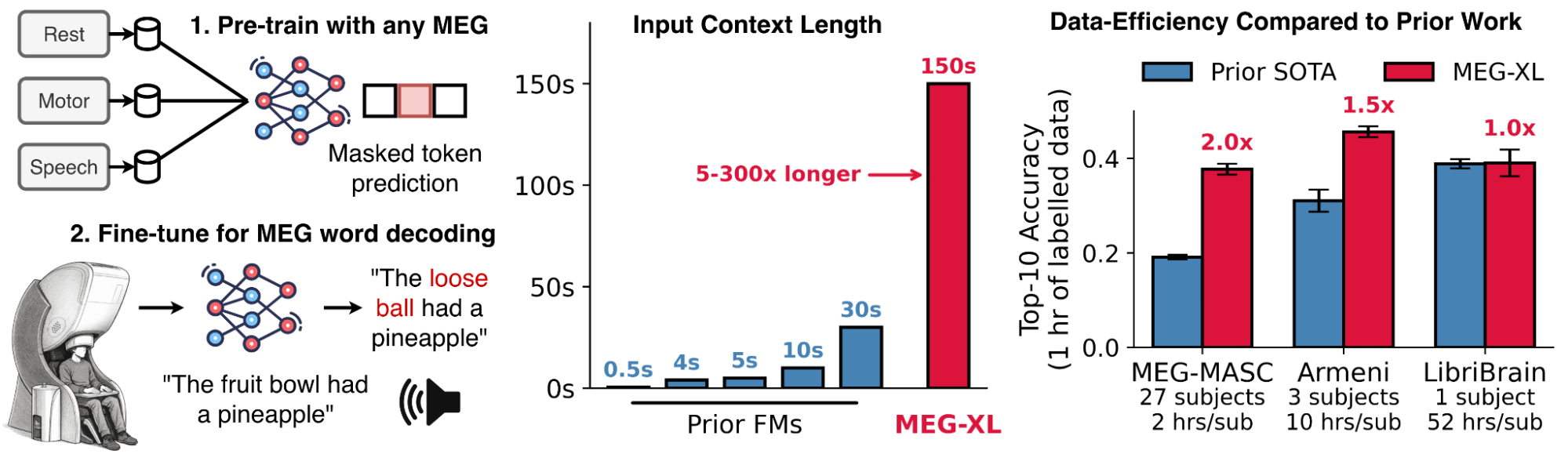
Figure 1. MEG-XL pre-trains on long stretches of MEG before fine-tuning for word decoding. The comparison uses one hour of labelled data per subject.
Across our experiments, we found that:
- Pre-training is most helpful when labelled subject-specific fine-tuning data is scarce. This is exactly what we want, as it is the regime most relevant to reducing the data collection burden for new users.
- With enough single-subject data, supervised training remains the gold standard. MEG-XL is therefore most valuable when collecting large amounts of new labelled data is impractical or even impossible.
- Longer pre-training contexts improve accuracy on brain-to-text. Increasing the amount of continuous neural activity used during pre-training improves the representations learned by the model.
- Models have to learn how to use long contexts. Giving a model more context after it has been trained on short windows does not lead to the same effect. Crucially, the long context must already be present during pre-training.
- Long-context models appear to use distant information selectively. Consistent with what we know about attention, MEG-XL learns when and how to use information from far back in time rather than treating everything in the preceding minutes as equally useful.
Taken together, these results suggest that long-context pre-training can partly offset the need to collect more labelled data from new subjects. There remains a substantial gap between these results and practical speech restoration, where performance is still far from that required for fluent communication, and will require generalisation to imagined or attempted speech. Nevertheless, these results meaningfully address an important bottleneck on the path to practical speech decoding brain-computer interfaces (speech BCIs).
A starting point for the broad track of the 2026 PNPL competition
The broad track of the PNPL competition asks participants to confront the problem we have discussed in this blog post. Rather than maximising performance after observing many hours from one person, models must learn what can be shared across people and adapt quickly when presented with someone new. MEG-XL provides one approach to doing this: pre-train across many subjects, expose the model to much longer stretches of neural activity, and then adapt the resulting representations using only a small amount of labelled data. We have open-sourced the MEG-XL model in hope that participants will use it as a strong starting baseline for the broad track and find ways to improve on it: public code and checkpoints should make it easy to start fine-tuning a pre-trained MEG-XL model. For technical details, please see the original MEG-XL paper. We’re excited to see what the community builds next.
📄Cite the paper
If you enjoyed this blog post, please cite the paper.
@inproceedings{jayalath2026megxl,
  title={{MEG-XL}: Data-Efficient Brain-to-Text via Long-Context Pre-Training},
  author={Jayalath, Dulhan and Parker Jones, Oiwi},
  booktitle={International Conference on Machine Learning (ICML)},
  year={2026},
  url={https://arxiv.org/abs/2602.02494}
}
References
The 2026 PNPL Competition: Word Classification and Efficient Cross-Subject Generalisation in LibriBrain100
Francesco Mantegna, Gereon Elvers, Dulhan Jayalath, Gilad Landau, Tasha Kim, Miran Özdogan, Luisa Kurth, Teyun Kwon, SungJun Cho, Benjamin Ballyk, Alex Fung, Anna Greer, Pratik Somaiya, Christian Herff, Yorguin Mantilla Ramos, Hamza Abdelhedi, Karim Jerbi, Greg Farquhar, Brendan Shillingford, Mark Woolrich, Oiwi Parker Jones
LibriBrain: Over 50 Hours of Within-Subject MEG to Improve Speech Decoding Methods at Scale
Miran Özdogan, Gilad Landau, Gereon Elvers, Dulhan Jayalath, Pratik Somaiya, Francesco Mantegna, Mark Woolrich, Oiwi Parker Jones
The Brain’s Bitter Lesson: Scaling Speech Decoding With Self-Supervised Learning
Dulhan Jayalath, Gilad Landau, Brendan Shillingford, Mark Woolrich, Oiwi Parker Jones
BrainOmni: A Brain Foundation Model for Unified EEG and MEG Signals
Qinfan Xiao, Ziyun Cui, Chi Zhang, Siqi Chen, Wen Wu, Andrew Thwaites, Alexandra Woolgar, Bowen Zhou, Chao Zhang
MEG-XL: Data-Efficient Brain-to-Text via Long-Context Pre-Training
Dulhan Jayalath, Oiwi Parker Jones
Towards decoding individual words from non-invasive brain recordings
Stéphane d’Ascoli, Corentin Bel, Jérémy Rapin, Hubert Banville, Yohann Benchetrit, Christophe Pallier, Jean-Rémi King